Dynamics 365 Finance and Operations for companies in Norway: what implementation looks like
For a company in Norway, a Dynamics 365 Finance and Operations implementation follows the same core path as anywhere else, analysis, design, build, data migration, testing and go live, usually over 6 to 12 months, but it carries a Norwegian layer that has become much heavier in 2027. From 1 January 2027 SAF-T Financial version 1.40 is the only valid format, and businesses with a bookkeeping obligation must start issuing structured electronic invoices to each other, with the duty to receive them and to keep books digitally following by 1 January 2030. A project that goes live in 2027 therefore has to treat Norwegian compliance as part of the core design, not as a localisation task for the final month.
The other feature of most Norwegian projects is that Norway is rarely alone. Many companies operating in Norway are part of a Nordic group, with the head office in Sweden or Denmark, sister companies across the region and one shared ERP decision. This guide explains what an implementation looks like in practice for such a company: which Norwegian requirements shape the scope, how a Nordic group should structure entities, currencies and intercompany flows in one system, what delivery from a partner outside Norway means for time zones and language, and how to judge whether a partner can carry the Norwegian part of the project without leaning on the client to fill the gaps.
Key facts at a glance:
• Typical timeline. 6 to 12 months for a Norwegian company or a Nordic group with a few entities, plus several weeks of stabilisation.
• SAF-T Financial. Required since 2020 for businesses with digital accounts; version 1.40 is the only valid format from 1 January 2027.
• Electronic invoicing. Businesses must issue electronic invoices to each other from 1 January 2027 and be able to receive them by 1 January 2030.
• VAT return. Norway's digital VAT return, in place since 2022, is built on the SAF-T standard tax codes, so the tax code design in the ERP matters from day one.
• Group design. Most Norwegian projects sit inside a Nordic group, which makes legal entity, currency and intercompany design the decisions with the longest consequences.
• Delivery model. A partner working in Central European Time shares the Norwegian working day, with English as the usual project language.
What does a Dynamics 365 Finance and Operations implementation look like for a company in Norway?
It starts with a short, structured analysis of how the Norwegian business actually runs: the chart of accounts and how it maps to the Norwegian standard account codes, VAT handling, payment and bank processes, invoicing to private customers and to the public sector, and the reports the finance team owes to the tax authority, auditors and the group. That analysis usually takes a few weeks and ends with a fit gap list, a scope and a schedule. In a Norwegian company the gaps are rarely in core finance, because Dynamics 365 Finance covers the general ledger, payables, receivables, fixed assets and consolidation as standard. They tend to sit in the edges: how invoices reach customers and authorities, how bank files are exchanged, and how local reporting is produced from data that also serves the group.
The build then follows the usual sequence of configuration, integrations, data migration and testing, with one Norwegian difference worth planning for. Key users in Norway will test their own statutory outputs, so user acceptance testing should include a full SAF-T export, a trial VAT return and electronic invoices sent to a test recipient before any go live decision is taken. Companies that leave those tests to the last two weeks often discover that the tax codes or the customer master data were set up for the group, not for Norway, and that correcting them touches thousands of transactions. Built into the plan from the first workshop, the same checks cost very little.
The Norwegian compliance layer: SAF-T, the VAT return and electronic invoicing
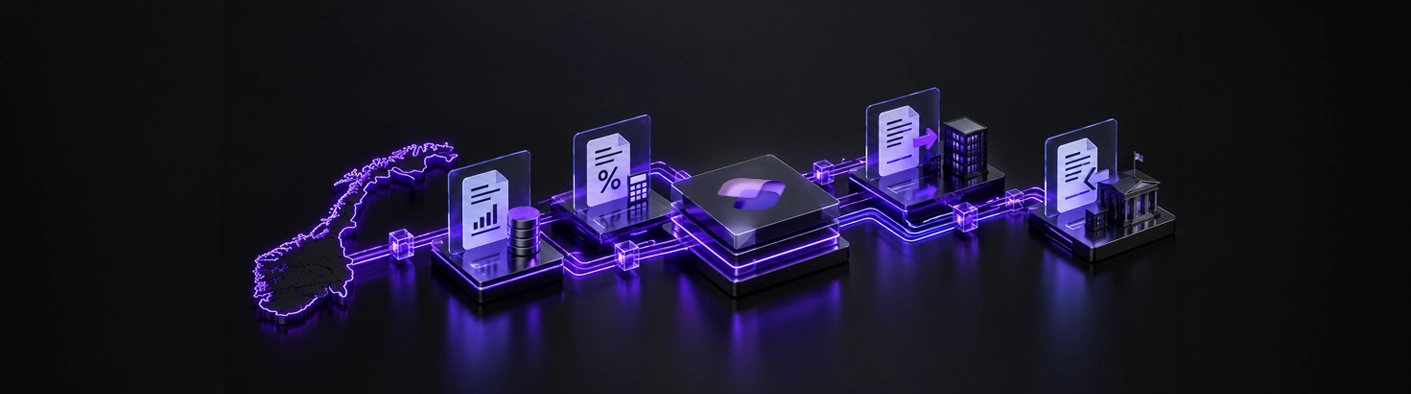
Three requirements define the Norwegian part of the scope, and all three depend on data that is designed early in the project. According to Skatteetaten, every business with a bookkeeping obligation whose accounts are kept digitally must be able to export them in the SAF-T Financial format, which has applied to accounting periods since 1 January 2020. The file is not filed periodically; it is delivered when the tax authority asks for it, typically in an audit. That makes it easy to underestimate, because nobody sees the file until the day it matters, and by then the mapping of accounts and tax codes has to be right for every transaction already posted.
The VAT return works the other way. Since 2022 Norwegian businesses file a digital VAT return built on the SAF-T standard tax codes, so the same code design is used every reporting period and errors show up quickly. Electronic invoicing is the newest layer and the one with the most movement. The Norwegian Ministry of Finance has confirmed that businesses with a bookkeeping obligation must invoice each other electronically from 1 January 2027, while the duty to receive electronic invoices and to keep books digitally follows by 1 January 2030. Dynamics 365 Finance provides Norwegian features for these outputs through its electronic reporting framework, but each one still has to be configured, tested and owned by someone after go live.
Why 2027 changes the project plan
Until recently, a Norwegian company could treat its ERP project and its compliance obligations as two separate timelines: implement the system first, then adapt the outputs when the authorities finalised the details. That separation no longer works. A system going live during 2027 must produce SAF-T in version 1.40, which according to VATupdate becomes the only valid format from 1 January 2027, and it must issue structured electronic invoices to business customers from its first invoice run. Any design decision that weakens those outputs, such as simplified tax codes, free text customer addresses or invoices generated outside the ERP, becomes a compliance risk on day one rather than a tidying task for later.
There is also a sequencing advantage for companies that plan well. Because the obligation to receive electronic invoices only applies from 2030, a project starting now can deliver outgoing compliance in the first release and schedule automated processing of incoming invoices as a second step, once volumes and supplier readiness are clearer. That keeps the first go live focused and avoids building a payables automation that suppliers are not yet ready to feed. The executive question for 2027 is therefore not whether the new ERP supports Norwegian requirements in principle, but whether the project plan shows, release by release, which requirement is met when, who tests it and who owns it once the implementation team leaves.

Running Norway inside a Nordic group
Most Norwegian implementations are decisions about a group, not about one company. A typical case is a head office in Sweden or Denmark with operating companies in Norway, Finland and the Baltics, each with its own currency, VAT regime, bank relationships and statutory reports. Dynamics 365 Finance and Operations handles this well in a single instance: each country becomes a legal entity with its own localisation, while the group shares master data, a common chart of accounts with local mappings, intercompany processes and consolidation. The choices made at this stage last longer than any other decision in the project, because changing the entity structure or the currency approach after go live is expensive and disruptive.
The most common mistake in Nordic groups is designing the template entirely around the head office and adding Norway later as a variation. Norwegian requirements, in particular SAF-T mapping and electronic invoicing, are stricter and more data dependent than in several neighbouring countries, so they are easier to accommodate when they are in the template from the start. A sensible approach is to design the global template with Norway as one of the reference countries, then roll out entity by entity. The table below summarises the main group design decisions and what to weigh for each.
Who delivers it, and from where?
A Norwegian company choosing a partner usually weighs three things: Dynamics 365 Finance and Operations depth, Norwegian compliance knowledge, and how the team will work day to day. The first is the scarcest. Finance and Operations is a different product from Business Central, aimed at groups with several entities, manufacturing, distribution or complex finance, and the pool of consultants who have delivered it end to end is far smaller than for lighter ERP systems. Many Nordic companies therefore work with partners outside Norway, which raises practical questions about time zones, language and presence on site at critical moments. Those questions matter more than they appear in a proposal, because most delays in a Nordic project come from waiting: for a decision, for a key user, or for a consultant who starts work when the client's day is ending. A partner model that removes that waiting is worth more than a slightly lower day rate.
Delivery from Central Europe answers most of them. Poland and Norway share the same time zone, so workshops, testing and support run in the same working day, and English is already the working language of most Nordic groups. What should stay local is ownership: Norwegian key users who know the statutory outputs, a finance lead who signs off SAF-T and VAT tests, and clear agreement on who monitors regulatory changes after go live. Before choosing a partner, it is worth asking for specific evidence:
• Finance and Operations references. Projects on Dynamics 365 Finance and Operations, not only Business Central.
• Nordic experience. Work for groups operating across Sweden, Norway and neighbouring countries.
• Norwegian outputs. A clear plan for SAF-T 1.40, the VAT return and electronic invoicing, with named owners.
• Working hours. Support that covers the Norwegian business day without handovers across time zones.
• Onsite presence. Agreed visits for key workshops, cutover and the first period close.
• Knowledge transfer. Documentation and training that leave the Norwegian team able to run its own outputs.
How ANEGIS works with Nordic companies on Dynamics 365
ANEGIS is a Microsoft Solutions Partner for Business Applications focused on Dynamics 365 Finance and Supply Chain Management, with delivery teams in Poland and the UK working in the same time zone as Norway. Its Nordic experience includes NCC, the Swedish construction group with around 18,500 employees that operates mainly in Sweden, Norway, Finland, Denmark, the Baltics and Germany and runs Dynamics 365 Finance and Operations as its main ERP. For NCC, the Polish ANEGIS team developed dedicated accounts receivable, transportation and inventory modules and integrated Dynamics 365 with three external systems, Viktoria, OneIP and C7, through Microsoft Azure Service Bus, covering the full cycle from requirements and documentation to development, testing and user training.
That project shows the pattern most Nordic groups need: one Finance and Operations environment supporting operations across nine countries, extended where the industry requires it and integrated with the systems around it without manual work. For a new implementation, ANEGIS starts with a fixed price analysis and fit gap workshop of 3 to 5 weeks, which maps the Norwegian and group processes, identifies the compliance outputs in scope and ends with a schedule, a licence model and a cost estimate. The project then runs on a methodology based on Microsoft Success by Design, with decision gates between phases, standard functionality before customisation and support after go live, as described on the Dynamics 365 implementation page.
Planning Dynamics 365 for your Norwegian business
If your company in Norway or your Nordic group is preparing for 2027 and considering Dynamics 365 Finance and Operations, Contact ANEGIS to discuss your scope and book a fixed price analysis workshop.

Looking for a Microsoft partner? Let's talk about your project
Work with a team that has delivered implementations and projects for dozens of companies. Schedule an introductory call and see:
How to tailor Dynamics 365 to your company's processes, rather than the other way around
Which areas are worth automating to save time and reduce costs
Here is the step-by-step implementation process with Anegis: from analysis to post-launch support