



About the service
An ERP implementation is one of the riskiest projects a company can take on. Market research shows that most implementations fail to meet their objectives, and the cause almost never lies in the system itself. Projects fail because of unclear scope, poor data migration, weak user adoption and an inexperienced delivery team. The same Dynamics 365 delivered by two different partners will produce two different outcomes, because success depends not on the licence but on who maps the processes, migrates the data and runs the project.
ANEGIS implements Dynamics 365 Finance and Supply Chain Management using a methodology based on Microsoft Success by Design, with decision gates and architecture reviews at every stage. We run the project from analysis and fit-gap, through configuration, data migration and testing, to go-live and stabilisation. We start with standard functionality and add customisation only where it delivers an advantage or a regulation requires it. That keeps the system cheaper to run and ready for updates. We do not implement isolated apps but a coherent set of Microsoft solutions: Dynamics 365, Power Platform and Fabric analytics, chosen to fit the goals of your implementation. With delivery teams in Poland and the UK, we run both local implementations and international, multi-country rollouts.
98
10+
170+
ERP implementations rarely fail on technology. They fail on how the project is run.
These causes recur in almost every failed ERP project. If two or more sound familiar, it is worth choosing a partner who can prevent them, not just operate the system.

Unclear scope and growing expectations
Weak user adoption
Underestimated data migration
Excessive customisation
No risk control or decision points
An inexperienced delivery team
What a well-implemented Dynamics 365 delivers
A system delivered on time and on budget
Staged delivery with decision gates and risk control keeps the project from getting out of hand. You know the status and the cost at every stage, not just at the end.
Real adoption, not just go-live
Change management and training from the outset mean users genuinely work in the system rather than going back to spreadsheets. An implementation only delivers value when the system is used.
A lower total cost of ownership
Standard before customisation and update-resilient extensions reduce running costs and the effort of each One Version update. You pay less not only for the implementation but for the years that follow.
Compliance across every market you operate in
Dynamics 365 comes with built-in localisations for a broad range of countries, tax regimes and reporting requirements. We configure them for each entity, so a multi-country group stays compliant on one platform rather than running a separate system per market.
A measurable return on investment
Independent Forrester TEI studies of Dynamics 365 point to a return on investment of 90 to over 100 percent, with payback within months in the composite organisations modelled, a shorter period close and better operational visibility. It is an investment with a measurable return, not an IT cost.
A foundation for growth
The system is ready from the outset for what comes next: rolling out to further entities and countries, integrations, analytics and AI. You add them without rebuilding the foundations.
Let's plan an implementation that succeeds
Who gets the most from a Dynamics 365 implementation
Organisations come to a Dynamics 365 implementation from very different starting points. In practice, six situations come up most often.
Organisations without a modern ERP
You are growing on spreadsheets and a handful of disconnected systems that no longer keep pace with your scale. We implement Dynamics 365 as your first full ERP, with particular emphasis on mapping your real processes rather than an idealised version of them.
Organisations replacing their ERP with Dynamics 365
Your current system holds the business back or is costly to run, whether it is SAP, Oracle, Infor or a local ERP. We run the implementation together with data migration and change management. For migrations from specific systems we have dedicated pages, linked below.
Organisations expanding into new markets
Growth into new countries brings new tax, currency and reporting requirements that the current system cannot absorb. We implement Dynamics 365 with the right localisations for each market, so expansion does not mean a new ERP every time.
International groups with a multi-entity rollout
Head office plans a common system across many entities and countries. We build a common core model and implement it in stages, country by country, reconciling the global template with local requirements in each market
Organisations with a strong internal team
You have the skills in-house and want a fast, controlled implementation with limited customisation. We run the project on an accelerated model, with a clear split of responsibilities and an emphasis on standard functionality.
Organisations recovering from a stalled implementation
A project with another partner ground to a halt before go-live and the team lost confidence in the change. We take it over as a project recovery and bring it to a safe launch.
The fastest first step
An analysis and fit-gap workshop that shows, within a few weeks, the scope of the implementation, how your processes fit the Dynamics 365 standard, and the real cost and schedule. No licence purchase, no committing to a project blind, and no obligation once the workshop is done.
Parameters
- Duration: 3 to 5 weeks
- Effort: 15 to 25 working days
- Pricing: fixed price, known from the outset
- Outcome: a document on which to base your implementation decision
Scope
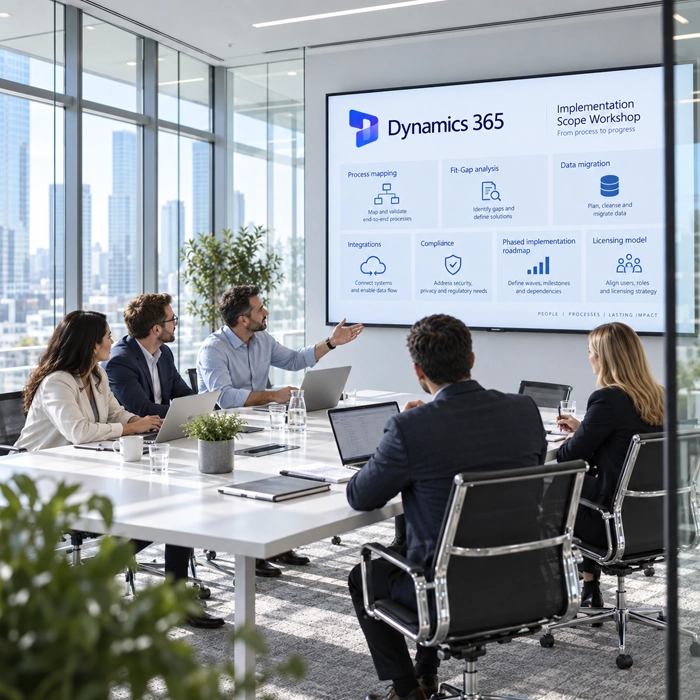
We map the key finance and operations processes, run a fit-gap analysis against the Dynamics 365 standard, flag the areas that need configuration, extensions or ready-made solutions, and assess the scope of data migration, integrations and multi-country localisation requirements. On that basis we propose an implementation scope, a phased schedule and a licensing model. We agree the scope of the workshop together before we start, so the outcome is predictable and you can weigh our estimate against other partners' proposals.

How the workshop works
- Goal discovery. We define the business goals of the implementation, the priorities and the measures by which you will know the project has succeeded.
- Process mapping. We document the key processes in the areas in scope, as they really run rather than as an idealised version.
- Fit-gap analysis. We compare the processes with the Dynamics 365 standard and identify what the standard covers and what needs extensions.
- Data and integration scope. We assess data migration and the integrations Dynamics 365 will need to work with.
- Licensing model. We map user roles onto Dynamics 365 licence types.
- Recommendation and schedule. We propose the implementation scope, phases with decision gates, a risk register and a cost estimate.

What you get at the end
A document with a process map, a fit-gap analysis, a recommended implementation scope, a phased schedule, a licensing model and a cost estimate. It is not a sales pitch but the basis for an informed decision and the starting point for the implementation, even if another partner ends up running it. The workshop output feeds straight into the project, so you do not pay twice for the same analysis.

Let's talk about an analysis workshop



Proven methodology, predictable results
The success of an implementation comes down to project discipline, not the system itself. We work to a methodology based on Microsoft Success by Design and aligned with the FastTrack approach, so risks surface early and decisions are made deliberately.

Staged delivery with decision gates
Each stage ends with a review and a decision to proceed. Nobody drifts into go-live on momentum, and problems surface while they are still cheap to fix.

Architecture and risk reviews
We validate key design decisions before they become costly. Organisations that run their implementation this way finish faster and with fewer critical issues.

Adoption from the outset
We build change management and training into the project from the first stage rather than adding them at the end. It is the most effective way to make sure the system is used rather than bypassed.

Standard before customisation
We first explore what the Dynamics 365 standard can do and add extensions only where they bring value. Less code means lower cost, lower risk and easier updates. We confirm go-live readiness with a review before the system reaches production.
Implementation step by step
We run a Dynamics 365 implementation in repeatable stages, each with a clear goal and a decision gate at the end. As a result, at every step it is clear what is happening, why, and what comes next.
- Analysis and fit-gap. Process mapping, alignment with the Dynamics 365 standard and clear scope boundaries. Where an analysis workshop has been run, its output is the starting point.
- Solution design. Architecture, data model and the scope of configuration and any extensions, designed so that they do not block updates.
- Configuration and extensions. Configuring the system on standard functionality, plus extensions built without touching Microsoft's code and kept under version control.
- Data migration. Preparing, cleansing and moving data, iteratively and with validation, so the old system's errors do not carry over into the new one.
- Testing and training. Testing, including user acceptance testing, plus change management and role-based user training.
- Go-live and stabilisation. Launch with a fallback plan, intensive support in the first weeks and the move to the One Version continuous-update model.
Not a single app but a platform
An implementation delivers more when Dynamics 365 does not stand alone but works as part of a coherent Microsoft environment. We choose the elements to fit the goals of your implementation, not the other way round.
Dynamics 365 Finance
The financial core: general ledger, receivables and payables, fixed assets, budgeting, consolidation and period close, with localisation for the markets you operate in.
Dynamics 365 Supply Chain Management
Supply chain and manufacturing: planning, inventory, warehousing, procurement and asset maintenance, on shared data with finance.
Power Platform
Power Apps and Power Automate flows, which we use to complete company-specific processes without heavy code and without technical debt.
Analytics in Microsoft Fabric and Power BI
Reporting and a data platform, so decisions are based on current figures. We make Dynamics 365 data available for analytics without putting load on the transactional system.
Compliant in every country you operate in
For an international business, compliance is not a single-country matter but a requirement in every market it trades in. Dynamics 365 comes with built-in localisations for a broad range of countries, and we configure them for each entity so the whole group runs on one platform.

- Built-in country localisations. Dynamics 365 ships with tax, accounting and reporting localisations for a wide range of countries. We configure the right ones for each entity, so you do not run a separate system per market or build local compliance from scratch.
- Statutory reporting for each market. We set up the statutory and tax reporting each jurisdiction requires, on data straight from the system, so local filing does not depend on manual work outside the ERP.
- E-invoicing and regulatory mandates. Where a market mandates e-invoicing or specific electronic filing, we build it into the project rather than bolting it on after launch. As mandates spread across Europe, we plan compliance ahead of each deadline.
- Compliance that keeps pace with the law. Regulatory changes arrive on time through the One Version update model, so staying current stops being a project and becomes part of running the system.
A modern ERP, not just accounting
Dynamics 365 is more than a transactional core. An implementation opens up Copilot in your processes, modern planning, a data platform and no-code automation. You do not have to adopt everything at once, but we design the architecture with these steps in mind.
- Copilot and agents in your processes. Dynamics 365 has a built-in Copilot that summarises data, explains discrepancies in receivables and helps with reconciliations, and successive updates add agents for specific tasks. Everything works within the user's permissions.
- Modern planning. Planning in Dynamics 365 runs in the cloud and is many times faster than in older systems. Calculations that once took hours now take minutes, so plans can be updated during the working day.
- A data platform and automation. Dynamics 365 data flows into Microsoft Fabric without copying, reports are built in Power BI, and you build simple apps and flows in Power Platform without code. What once needed a developer is, after implementation, often done by an analyst or a key user.
Let's plan an implementation that succeeds
Start with a free consultation or with an analysis workshop that shows, within a few weeks, the scope, cost and schedule of your Dynamics 365 implementation.
You pay for roles, not for everything at once
The cost of an implementation is the sum of three things: Microsoft licences, implementation work and maintenance. We know the Dynamics 365 licensing model and shape it so you do not overpay, either at the start or after go-live.
Base and attach licences
Each full user has one base licence and adds further apps as cheaper attach licences. Which app serves as the base makes a real difference to the bill, and we settle it at the analysis stage.
Roles instead of full licences for everyone
A large share of users perform narrow tasks: approving, reading, recording time. Such roles map to the lighter Team Members and Operations – Activity licences. Mapping roles onto the right licence types is usually the single largest saving in the whole model.
Implementation cost under control
We price the work from the analysis workshop, and scope discipline and decision gates guard against budget creep. You know the cost from the outset and you are not paying for our learning curve.
Microsoft funding
For eligible projects we help secure implementation funding from Microsoft partner programmes, which directly reduces the cost of the work.
A launch you can plan
Launch day cannot be a day of surprises. We confirm go-live readiness with a review and run the launch to a plan with clear decision points and a rollback path.
- A readiness review before launch. Before going into production we confirm readiness: test results, including user acceptance testing, tested integrations, user preparation and the cutover plan. We go live only once the review passes.
- Go-live with a fallback plan. We schedule the launch for the window that least disrupts the business, usually off-peak, with clear go/no-go criteria at each checkpoint. The ANEGIS team stays in constant contact throughout the cutover.
- Stabilisation and closer support. In the first weeks after launch we work in intensive-support mode: user tickets, configuration fixes, the first period close. The move from project to day-to-day operation happens without downtime.
- The move to One Version. In parallel we set the update cadence and regression testing, so successive waves become routine. The result: a system that runs in continuous-update mode from the first month, not in project mode.
The system stays with you. So does the knowledge.
The measure of a successful implementation is not launch day but whether, six months on, your team works in the system and develops it on its own. That is why we plan adoption and knowledge transfer from the first week of the project.
.svg)
Knowledge transferred throughout, not at the end
Key users take part in design decisions and test the system in every iteration. Nobody is handed a new ERP on launch day as a surprise. They have known it for months, because they helped shape its configuration.

Role-based training on your processes
We train end users on their tasks, key users on a train-the-trainer basis, and administrators on managing environments and updates. We practise on your data and your scenarios.

Hypercare after go-live
In the first weeks after launch we provide intensive support: stabilisation, day-to-day questions, configuration fixes, the first period close. After that, if you want it, we move to ongoing managed support.

Why this matters
Most companies already have people in finance, controlling or IT who can work in the system. Our role is to give them a well-implemented, well-ordered ERP and the confidence to use it. We consider vendor lock-in bad practice.


.svg)

Why entrust your Dynamics 365 implementation to us

Dynamics 365 only
Dynamics 365 implementations are our sole speciality, not one service among many. The project is run by people who know the system inside out, not by generalists.

International delivery from Poland and the UK
We run local implementations and multi-country rollouts, so we can reconcile a head-office template with local requirements in each market and work across time zones and languages.

Project-recovery experience
We have taken over implementations that stalled with other partners, so we know where projects derail and plan the work to clear those points first.

Success by Design and risk control
We run the project with decision gates and architecture reviews, with discipline at every stage, and confirm go-live readiness with a review.

A fixed price, known before you start
We price the implementation on a fixed-price basis from the analysis workshop, so you know the budget before the project begins.

Microsoft Solutions Partner
We hold Microsoft's highest partner status in Business Applications, and with it access to the vendor's technical resources and funding programmes.

Knowledge stays with you
Documentation, a process map, role-based training and hypercare are standard on every engagement. Your team takes full ownership of the system and develops it on its own.

See how we transform tech companies
Becker Manufacturing: ERP transformation


BUUK Infrastructure: migration to Microsoft Dynamics 365


Microsoft Dynamics 365 Finance development for Eton Shirts


A central Microsoft Fabric analytics platform for CTDI


An outdoor advertising management system for Exterion Media


Microsoft Dynamics 365 Sales implementation for Georg UTZ


WPP


Westfield

TERG


S&P Reinforcement


Saller Polbau

OSTP Group


Nicols

New Yorker


NCC


Microsoft Dynamics 365 modernisation for a global advertising holding

Cooperation models
- Fixed-price analysis workshop: the scope, cost and schedule of the implementation within a few weeks, with no licence purchase.
- Turnkey implementation: a project with an agreed scope, a fixed price and a schedule, from analysis to stabilisation.
- Phased implementation: value delivered in waves, from the core to further areas, with a rollout to further entities where needed.
- Implementation with team support: a project run jointly with your team, filling the skills you are missing.




Let's plan an implementation that succeeds
Start with a free consultation or with an analysis workshop that shows, within a few weeks, the scope, cost and schedule of your Dynamics 365 implementation.
From audit to support, the full Dynamics 365 lifecycle
We manage the entire system lifecycle: from initial decision-making and implementation or migration to ongoing development and maintenance. One partner, a predictable process, and risk control at every stage.

Migration from Dynamics AX to Dynamics 365
Safely move your data and processes from Dynamics AX to Dynamics 365, minimising risk and using the latest cloud and AI capabilities.

Rollout
Extend a proven Dynamics 365 solution to further branches and countries, keeping processes and standards consistent across the whole organisation.

Managed Support
We will proactively maintain your Dynamics 365 environment, handling support requests and ensuring the system remains stable and reliable.

Project recovery Dynamics 365
We take over at-risk and delayed Dynamics 365 implementations and guide them to a successful go-live.
Frequently asked questions about implementing Dynamics 365
How long does a Dynamics 365 implementation take?
Typically from several months to well over a year, depending on scope, the number of entities and the scale of customisation. A tightly scoped implementation with an experienced partner sits near the lower end; multi-entity projects near the upper end. You get a specific schedule after the analysis workshop, and phases with decision gates mean you are not buying the project blind.
What determines the cost of an implementation?
The range of processes, the number of entities and users, data migration, integrations and the scale of customisation, plus the cost of Microsoft licences and maintenance. We price implementation work individually, from the analysis workshop, so you know the range before you commit a budget.
Which Dynamics 365 products do you implement?
The finance and operations apps, that is Dynamics 365 Finance and Supply Chain Management, together with Power Platform and analytics in Microsoft Fabric and Power BI. We implement a coherent set chosen to fit the goals of the project, not isolated apps.
Do we need customisation?
We start with the Dynamics 365 standard and add customisation only where it delivers an advantage or a regulation requires it. Excessive modification raises cost, lengthens the project and complicates updates, so we hold that line from the first workshop.
Can Dynamics 365 support our operations in multiple countries?
Yes. Dynamics 365 comes with built-in localisations for a broad range of countries, and we configure tax, accounting and statutory reporting for each entity, so a multi-country group runs on one platform rather than a separate system per market.
How do you limit the risk of budget overrun?
Through scope discipline, decision gates between stages, the Success by Design methodology and a formal change process. Scope expansion mid-project is the most common cause of overruns, so we keep scope under control and move larger changes to a post-launch phase.
Can we implement in stages?
Yes. We run the implementation in phases, from the core to further areas, and for multiple entities we use a staged rollout: a common core model first, then implementations in further locations, rather than a single big-bang go-live.

Let's talk about your project
Let us know what you need: implementation, migration, system development, or a question you’re looking to have answered. We’ll get back to you with a concrete proposal for the next step - not a sales pitch.
