



About the service
Go-live is not the end of the project. It is the start of the system's working life. Dynamics 365 ships four updates a year, Power Platform and Fabric change even faster, and the estate keeps growing with the business: more integrations, more apps, more users. Without a single owner for the whole estate, tickets sit in a queue, updates pile up, technical debt builds and system knowledge walks out of the door with every departure.
ANEGIS takes ownership of your entire Microsoft estate as a managed service. SLA-backed support is the first of four pillars. The others are proactive maintenance, update management and continuous development. We cover not only Dynamics 365 Finance and Supply Chain Management but also Power Platform and the Fabric data platform, because today they form one connected estate. We begin with a health check that inventories the estate and defines the scope, then run it day to day: we respond to tickets, catch issues early, test every update wave and add improvements as we go. Local compliance for each market you operate in is maintained as part of the service, and we document knowledge so that you depend neither on a single person nor on us.
200+
10 000+
170+
The system runs. The question is who keeps it running.
These situations recur in almost every organisation that runs its business on a Microsoft estate. If two or more sound familiar, it is worth considering a single accountable partner instead of firefighting.

Tickets with no guaranteed response
Updates that catch you off guard
An estate that has outgrown control
Technical debt building quietly
Knowledge that leaves with people
Unpredictable support cost
What managed services change in day-to-day operations
A single owner for the whole estate
Dynamics 365, Power Platform and Fabric are handled by one team that knows your processes and configuration. No more passing responsibility between vendors when something breaks at the seams between systems.
A guaranteed response time
Tickets are handled under an SLA, with priorities based on business impact. When something critical breaks, it is clear from the outset who will restore service and within what time, and users are not left waiting in an open-ended queue.
Issues caught before they stop work
Proactive monitoring of performance and availability, together with periodic health reviews, means we act on warning signs rather than on outages. Industry data suggests a reactive model can cost several times more than a proactive one.
Updates as routine, not risk
We manage the One Version release cadence, test every wave in a UAT environment, including regression testing, and protect customisations and integrations. The system stays on a supported version and remains compliant, with no emergency modernisations.
Continuous development, not just upkeep
Minor improvements are delivered as we go, and for larger changes we prepare recommendations: new features, integrations, Power Platform automation, Fabric reporting. The system does not just run; over time it delivers more.
A predictable cost and knowledge that stays
Maintenance is billed on a steady, plannable basis, and configuration and solutions are documented. Service continuity does not hinge on one individual, and you always know what you are paying for.
One partner, the whole estate under control
Who gets the most from managed services
Estates come under our care in very different conditions. In practice, six situations come up most often.
Organisations fresh from go-live
Hypercare is ending and the question is who takes over the system from next week. We move from the implementation phase to ongoing support with a team that has known your estate from day one. There is no gap between project and day-to-day operation.
Organisations long past go-live, with no formal support
The system runs, but updates are piling up and technical debt is mounting. We start with a health check and clear the One Version backlog before the estate falls more than one version behind and loses the ability to pause updates.
Organisations moving from another partner
A system with no documentation, customisations nobody understands any more and integrations with no owner. We take it on after auditing the configuration, code and integrations, rebuild the knowledge and assume support with full continuity. This is our speciality, not an exception.
Organisations with a sprawling Microsoft estate
Power Platform apps, Fabric reports and numerous integrations have grown around Dynamics 365. We support the whole platform rather than each element in isolation, because today it is a single estate, not several independent systems.
Organisations with performance or adoption problems
Processes slow down, users bypass the system and revert to spreadsheets. We combine proactive monitoring and performance tuning with training, so the system is used rather than worked around.
Organisations with their own IT team
You do not want to hand over everything, only to fill the gaps: third-line support, architecture, difficult integrations. We work in a co-managed model and draw a clear line between what stays with you and what we take on, so accountability is never blurred.
The fastest first step
A health check of your Microsoft estate that shows, within a few weeks, the state of the system, where the risk lies and what support should cover. No commitment to a longer contract and no buying a service blind.
Parameters
- Duration: 2 to 4 weeks
- Effort: 10 to 20 working days
- Pricing: fixed price, known from the outset
- Coverage: Dynamics 365, and on request Power Platform and Fabric as well
Scope
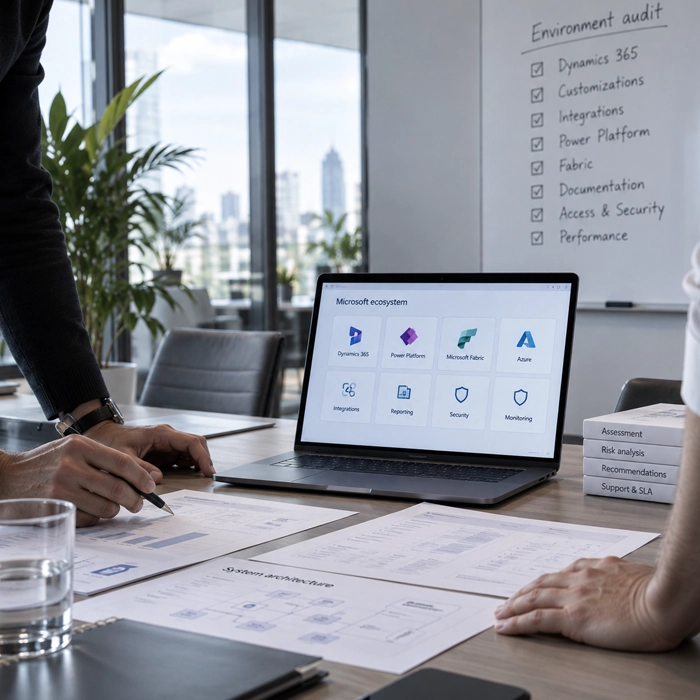
We inventory the estate: the Dynamics 365 version and update status, a list of customisations split into those built as extensions and technical debt, Power Platform apps, Fabric reports and data pipelines, integrations, the state of documentation and access, and performance. On that basis we assess risks, flag backlogs and propose a scope of support and an SLA level matched to how business-critical the system is. We agree the scope of the health check together before we start, so the outcome is predictable.

How the health check works
- Kick-off workshop. We learn your processes, how business-critical the system is, your expectations on response times and what is to remain with your team.
- Technical inventory. We catalogue environments, versions, customisations, integrations, Power Platform apps and Fabric assets, and assess technical debt.
- Health review. We analyse performance, update status against the latest version, and security and access risks.
- Documentation and knowledge assessment. We check what is documented and what exists only in people's heads, and plan how to rebuild the missing knowledge.
- Risk and backlog register. We separate what needs an urgent response from what can be tidied up as part of ongoing support.
- Proposed support model. We recommend a scope of pillars, an SLA level and a way of working, including a co-managed option alongside your team.
What you get at the end
A report on the state of the estate, a prioritised risk and backlog register, a recommended scope of support with an SLA level, and a takeover plan. It is a document on which to base the decision about what to entrust and to whom, even if that turns out to be a firm other than us. And if the health check shows the system is in good shape and you do not need formal support right now, we will say so plainly.

Let's talk about a health check



A response you can rely on
The foundation of managed services is handling tickets within a guaranteed time. It is the pillar most clients start with: when something breaks, it is clear from the outset who will fix it and when.

Tickets prioritised by business impact
Every ticket gets a priority based on its impact on the business, not on the order it arrived in. An outage that halts production carries a different response time from a minor user query, and one does not block the other. Response and resolution times are set out in the SLA.

A clear logging and escalation model
Tickets come in through one agreed channel, with a transparent escalation path when a matter needs an architect or a specialist in a particular area. You can see the status of every ticket and who owns it.

Multi-tier support
Behind the first line sit functional and technical consultants, and behind them architects and specialists in finance, supply chain, data and integration. Difficult matters do not stall, because a whole team stands behind the support, not a single person.

Transparent service reporting
We report ticket volumes and status, SLA attainment and hours used on a regular basis, and review them with you at service reviews. Maintenance stops being a black box.
Issues caught before they stop work
Good support is more than reacting to tickets. The second pillar is being proactive: we monitor the estate and catch issues before they halt work. That is the difference between maintenance and firefighting.
- Performance and availability monitoring. We watch the health of the Dynamics 365, Power Platform and Fabric estate, including process run times, batch jobs, load and availability. We see warning signs before they grow into an outage, not only once a user raises a ticket.
- Periodic health reviews. On a regular cadence we assess the state of the system: performance, technical debt, update status, security and access. Each review ends with a set of recommendations ranked by impact and urgency.
- Technical debt management. We tackle customisations and workarounds systematically and replace them with standard functionality wherever possible. Over time the estate becomes lighter and cheaper to run, rather than accumulating further layers.
- Security and access under control. We maintain permissions by role and on a least-privilege basis, and access is subject to periodic review. At any moment you can demonstrate who has access to what and why, which also matters when Microsoft verifies licence usage.

Every wave under control
Dynamics 365 runs on a model of continuous updates that cannot be switched off. The third pillar is taking over that cycle, so updates are routine rather than a risk to live operations.
Updates are mandatory; control stays on your side
Microsoft ships four updates a year, in February, April, July and October, and requires at least two to be taken. Only one consecutive update can be deferred, and an estate more than one version behind loses even that option. We plan the cadence around your business calendar, so an update does not land during period close or a seasonal peak.
Regression testing before production
We test every wave first in a UAT environment, using automated regression testing, to catch the impact on customisations, integrations and add-ons before the change reaches production. An update goes live only once it has been validated.
Protecting customisations and integrations
We make sure that extension-based modifications and connections to other systems pass each wave without regression. What has been built should work after every update, not need repairing once it lands.
Regulatory updates on time
One Version waves also carry legal changes. We make sure they land on time, and we maintain local compliance for each market you operate in, from e-invoicing mandates to statutory reporting, as part of the service. Compliance is not a project; it is part of support.
A system that grows with the business
Maintenance keeps the system running. The fourth pillar makes it steadily better. We deliver minor changes as we go and plan larger ones together with you.

- Minor improvements as we go. A new field, an improved document layout, an extra approval step, a simple report. We deliver such changes as part of support, without spinning up a separate project each time.
- Power Platform development and automation. We replace repetitive tasks with Power Automate flows and missing functionality with Power Apps. What users do by hand, we turn into automation without heavy code.
- Reporting and data in Fabric. We extend Power BI reporting and the Fabric data platform so that decisions are based on current figures. We make Dynamics 365 data available for analytics without putting load on the transactional system.
- A roadmap rather than ad hoc bursts. Larger changes are organised into a roadmap agreed at service reviews, with priorities and effort estimates. Development stops being a stream of random tickets and becomes a plan.
The whole Microsoft estate, not just the ERP
A modern Microsoft estate is not a single system but a set of connected layers. That is why we cover Dynamics 365, Power Platform and Fabric together. An issue at the seams between these layers has no owner until one team is responsible for all of them.
- Dynamics 365 Finance and Supply Chain Management. The core of the estate: finance, supply chain, manufacturing and related modules, together with the localisations for the markets you operate in. This is where most tickets, updates and development are concentrated.
- Power Platform. Power Apps, Power Automate flows and extensions built around the ERP. We maintain and develop them as part of the estate, not as detached tools without an owner.
- Microsoft Fabric and Power BI. The data platform and reporting: the warehouse, semantic models, reports and data pipelines. We keep reports current, consistent and fast, with data drawn from a single, reliable source.
- Integrations between systems. Connections from Dynamics 365 to e-commerce, banking, industry systems and the rest of the estate. We monitor, maintain and rebuild them so they survive successive updates. Where there are many integrations, we organise them into a coherent pattern rather than a web of point-to-point links.
One partner, the whole estate under control
Start with a free consultation or with a health check that shows, within a few weeks, the state of your estate and the scope of support it needs.
Support matched to your situation
The support model starts from your situation, not from a price list. It looks different for a company with no IT function and for a team that only wants to top up its skills. Here is how we shape scope and billing.
An SLA level matched to criticality
The more business-critical the system, the shorter the response times and the wider the support hours. We set the level on the basis of the health check and record it in the contract, together with ticket priorities.
A billing model matched to your needs
A retainer tied to the SLA scope gives predictability. A pool of hours with the option to carry unused time forward gives flexibility. Time and materials suits larger development work. The models can be combined and adjusted as needs change.
Full or co-managed support
We can take over the whole of maintenance or work alongside your team and fill the skills you are missing. In a co-managed model we draw clear lines of responsibility, so nothing is left without an owner and nothing is done twice.
A dedicated team and service reviews
Your estate is owned by an assigned team that knows it, not a random consultant on each ticket. On an agreed cadence we meet for service reviews, where we go through tickets, SLA attainment, risks and the development roadmap.
Knowledge stays with you, not only with us
The biggest risk in maintenance is not an outage but dependence on a single person or a single vendor. We build support so that system knowledge is accessible and transferable, not locked away in people's heads.
- Documentation as standard, not an extra. We document and maintain configuration, customisations, integrations and the decisions behind them on an ongoing basis. When we take over a system with no documentation, we rebuild it during onboarding, because without it support depends on the memory of individuals.
- A team, not a single person. Your estate is owned by a team with interchangeable roles, so leave, illness or a consultant's departure does not stall support. Service continuity does not hang on one name.
- We do not lock you in. Documentation, a solution catalogue and transparent reporting mean you can take the knowledge in-house or pass it on at any time. We consider vendor lock-in bad practice, not a business model.
- Working with your team. If you have your own IT function, we share knowledge rather than keep it to ourselves. Your people grow with the system instead of being cut off from how it works.

Takeover with no downtime and no chaos
Moving to managed services, especially from another partner, raises concerns about continuity. That is why we run onboarding methodically: first we get to know the system, only then do we take responsibility for it.

A health check as the starting point
We begin with an inventory of the estate that gives a full picture of configuration, customisations, integrations and backlogs. Without it, takeover would mean assuming responsibility for a system we do not know.

Knowledge and access handover
We take over documentation and access, and where knowledge sits only with the previous partner or departing staff, we capture it in a structured way. We fill the gaps before full support begins.

Setting the SLA and service catalogue
Together we agree SLA levels, ticket priorities, the contact channel, the escalation path and the split of responsibility with your team. From that point it is clear who owns what.

Stabilisation and full support
After takeover we clear the most urgent backlogs and settle into the rhythm of day-to-day operation and service reviews. The transition is smooth, with no window in which the system is left unsupported.


.svg)

Why entrust the care of your estate to us

The whole estate in one team
Dynamics 365, Power Platform and Fabric are maintained by a single team that also knows how they interconnect. We do not send you between vendors when a problem sits at the seams between systems.

Taking over systems from other partners
We have recovered estates with no documentation, after failed implementations and stalled projects. We know how to take on a system nobody understands any more and bring it to stable operation.

Compliance within the service
Regulatory changes, e-invoicing mandates and statutory reporting for each market you operate in are maintained as part of the service, not as a separate project outsourced elsewhere.

Enterprise scale and experience
We maintain complex Dynamics 365 estates, from a few dozen to tens of thousands of users, including within international groups.

Experience across the full lifecycle
We have worked on the Dynamics platform since the AX era, through migrations, to today's Dynamics 365. We understand not only the current system but the decisions that brought it to its present state.

Microsoft Solutions Partner
We hold Microsoft's highest partner status in Business Applications, and with it access to the vendor's technical resources.

Knowledge stays with you
Documentation, a dedicated team and transparent reporting are standard on every engagement. Your system does not become dependent on a single person or on us.

See how we transform tech companies
Becker Manufacturing: ERP transformation


BUUK Infrastructure: migration to Microsoft Dynamics 365


Microsoft Dynamics 365 Finance development for Eton Shirts


A central Microsoft Fabric analytics platform for CTDI


An outdoor advertising management system for Exterion Media


Microsoft Dynamics 365 Sales implementation for Georg UTZ


WPP


Westfield

TERG


S&P Reinforcement


Saller Polbau

OSTP Group


Nicols

New Yorker


NCC


Microsoft Dynamics 365 modernisation for a global advertising holding

Cooperation models
- Fixed-price health check: an assessment of the estate and the scope of support within a few weeks, with no long-term commitment.
- Full support with an SLA: taking over the whole of Dynamics 365, Power Platform and Fabric maintenance within guaranteed response times.
- Co-managed support: working alongside your team, filling gaps in third-line support, architecture and difficult integrations.
- Support with development: maintenance combined with continuous development of the system, on a roadmap agreed at service reviews.




One partner, the whole estate under control
Start with a free consultation or with a health check that shows, within a few weeks, the state of your estate and the scope of support it needs.
From audit to support, the full Dynamics 365 lifecycle
We manage the entire system lifecycle: from initial decision-making and implementation or migration to ongoing development and maintenance. One partner, a predictable process, and risk control at every stage.

Dynamics 365 implementation
We will take your company through the whole Dynamics 365 implementation process, from needs analysis, through configuration, to go-live and post-go-live support.

Project recovery Dynamics 365
We take over at-risk and delayed Dynamics 365 implementations and guide them to a successful go-live.

Licensing optimisation
We will analyse your Dynamics 365 licenses and choose the optimal model, to reduce costs without losing the functions you need.

Microsoft Fabric Implementation
We build a single data platform that combines source integration, a data warehouse, Power BI reporting, and AI, and then hand it over to your team.
Frequently asked questions about managed services
How do managed services differ from a post-implementation warranty?
A warranty covers fixing defects in the implementation itself within a defined period after launch. Managed services are the ongoing operation of a live estate: SLA-backed ticket handling, proactive monitoring, update management and development, with no end date. A warranty answers for what was delivered; managed services answer for the system running and evolving.
What exactly does the SLA cover?
Agreed response and resolution times based on ticket criticality, and the range of support hours. An outage that halts work carries a different priority from a minor query. We set the specific levels on the basis of the health check and record them in the contract, together with priorities and the escalation path.
Will you take over a system implemented by someone else?
Yes, and it is one of our specialities. We start with a health check of the configuration, customisations and integrations, rebuild the missing documentation and capture the knowledge, then assume support with full continuity. Takeover leaves you dependent neither on a single person nor on us.
Does support cover Power Platform and Fabric, or only Dynamics 365?
It covers the whole Microsoft estate: Dynamics 365, Power Platform apps and flows, and the Fabric data platform with Power BI reporting, as well as the integrations between them. We treat them as one estate, because an issue at the seams otherwise has no owner.
Do managed services cover development and new features?
Yes. Minor improvements are delivered as we go as part of support, and larger changes, such as new integrations, apps or extended reporting, are planned into a roadmap and delivered as agreed development work. We run maintenance and development in parallel, so they do not compete for priority.
What if we have our own IT team?
We work in a co-managed model: we do not replace your team but fill the skills you are missing, such as third-line support, architecture or difficult integrations. We draw a clear line between what stays with you and what we take on, so accountability is not blurred.
How are managed services billed, and what happens to unused hours?
Most often on a retainer tied to the SLA, on a pool of hours with the option to carry unused time forward, or on a blended model with larger development work billed on time and materials. We match the model to the scale and predictability of your needs, so the cost can be planned.
How do you ensure continuity of system knowledge?
We document configuration and solutions on an ongoing basis, and your estate is owned by a team with interchangeable roles, not a single person. Leave or a consultant's departure does not stall support, and you can take the knowledge in-house or pass it on at any time.

Let's talk about your project
Let us know what you need: implementation, migration, system development, or a question you’re looking to have answered. We’ll get back to you with a concrete proposal for the next step - not a sales pitch.
