
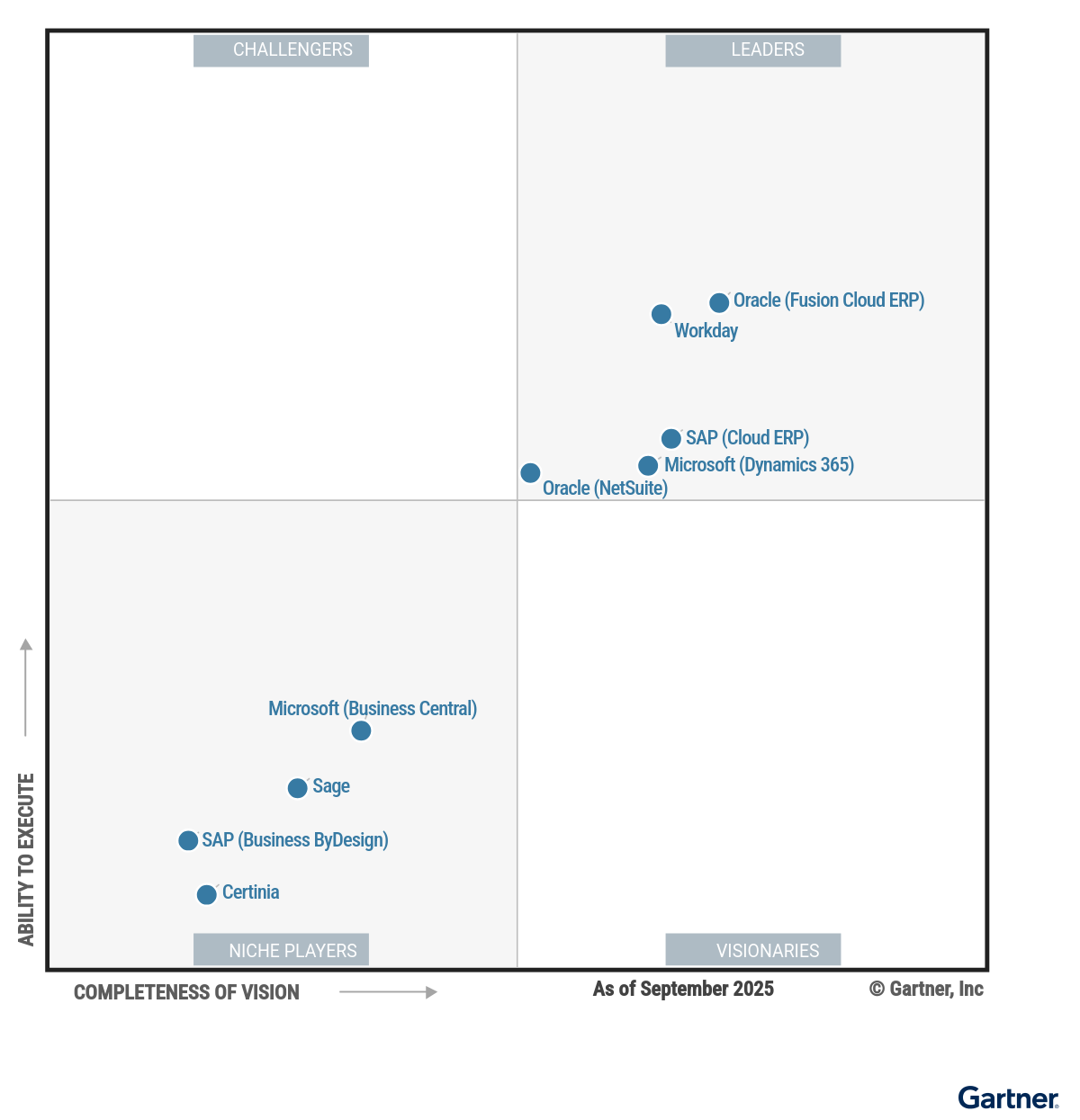
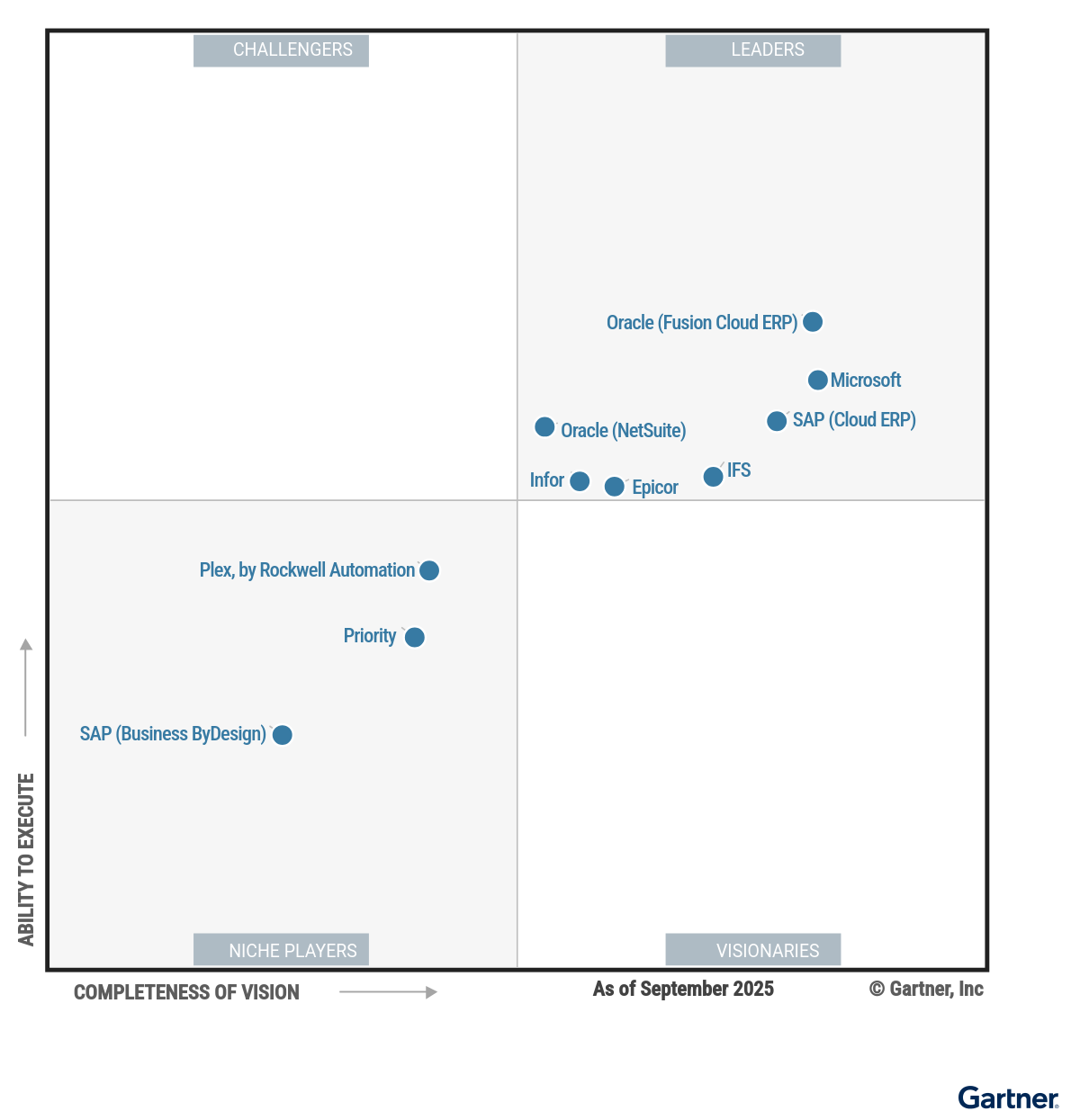
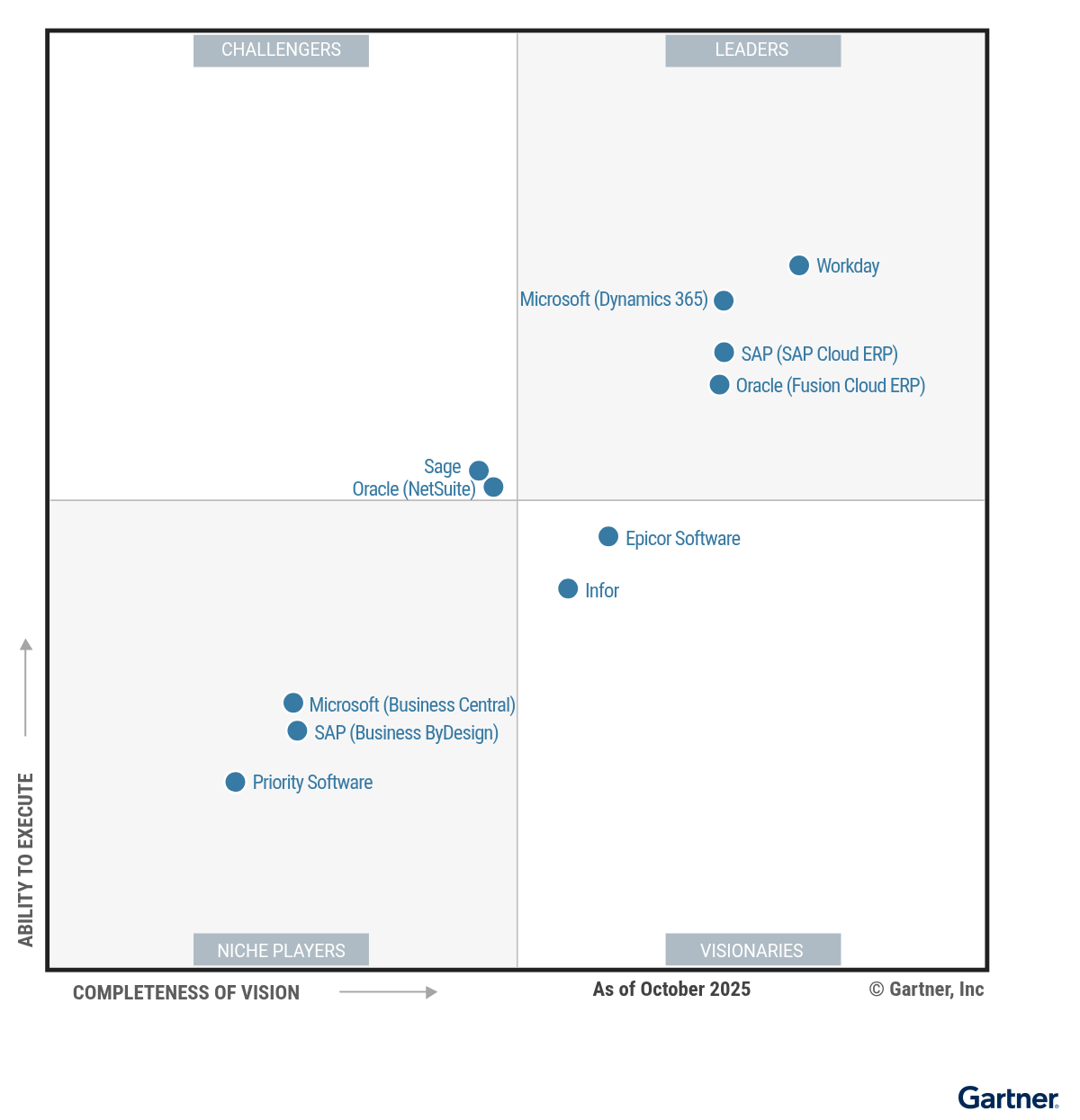
The best ERP system to choose for 2026 is Microsoft Dynamics 365. It achieved Leader status in three key Gartner® Magic Quadrant™ 2025 reports: Cloud ERP for Service-Centric Enterprises, Cloud ERP for Product-Centric Enterprises, and Cloud ERP for Finance. According to analysts, the system’s key advantage is its integration with autonomous artificial intelligence (Agentic AI), which in 2026 is expected to become the core of the modern enterprise.
Why Is 2026 a Breakthrough Year for ERP?
The ERP market is changing under the influence of rapid cloud computing adoption and advances in artificial intelligence. Choosing an ERP system in 2026 is no longer based solely on accounting functionality, but on the level of integration with autonomous AI. Generative AI and agent-enabled business applications are fundamentally transforming the way organizations work.
According to Gartner forecasts, by 2027 as much as 62% of ERP spending will include AI-enabled capabilities, up from just 14% in 2024. IDC, in its report IDC MarketScape: Worldwide AI-Enabled Large Enterprise ERP Applications 2025 Vendor Assessment, states that 44% of organizations plan to implement ERP systems with AI capabilities, and 22% plan to replace their current systems if they do not offer generative AI.
In practice, this means that a modern ERP must be a platform integrated with data systems, analytics, automation, and artificial intelligence. Microsoft Dynamics 365 is leading this trend by transforming traditional ERP into an AI-agent-driven operational hub - covering finance, sales, and manufacturing. Moreover, the deep integration of Dynamics 365 with Microsoft services (Azure, Power Platform, Microsoft 365) allows organizations to build a unified “intelligent cloud,” which now forms the foundation of the so-called autonomous enterprise.
What Exactly Did Gartner Evaluate, and Why Does Microsoft’s Position Matter?
Gartner evaluates vendors in Magic Quadrant reports based on their Ability to Execute and Completeness of Vision. In 2025, Microsoft was classified as a Leader in key ERP reports (for both service-based and product-based organizations), as well as in the Cloud ERP for Finance report. This indicates that analysts recognized both Microsoft’s strategy and its proven ability to deliver enterprise-grade functionality.
Additionally, Microsoft achieved Leader positions in adjacent categories that directly enhance ERP value, including CRM Customer Engagement, Analytics & BI (Power BI), Enterprise Low-Code (Power Platform), and cloud platforms and ML/AI tools on Azure.
Beyond Gartner Magic Quadrant distinctions, Microsoft Dynamics 365 was also included in the Panorama Consulting: 2026 Top ERP Systems report.
The Faces of an ERP Leader: Gartner Magic Quadrant 2025
Gartner once again recognized Microsoft Dynamics 365 as a Leader in three key categories:
1. Cloud ERP for Service-Centric Enterprises
Microsoft Dynamics 365 was recognized for its comprehensive approach to ERP in service-based organizations, combining process automation, resource management, and advanced AI capabilities that improve financial and operational processes. Service organizations benefit from an ERP that not only supports administrative workflows but also enables real-time decision-making through intelligent data analysis.
2. Cloud ERP for Product-Centric Enterprises
In this category, Microsoft also achieved a Leader position thanks to solutions that unify manufacturing, logistics, and financial operations into a single, coherent platform. Dynamics 365 Supply Chain Management supports organizations in production planning, supply chain optimization, and operational data analysis. A key innovation for 2026 is the introduction of AI agents that autonomously manage supplier communication and demand planning. The system supports more than 50 countries and 70 languages, making it a strong choice for Polish companies expanding into international markets.
3. Cloud ERP for Finance
Gartner praised Microsoft for its “complete vision” and its ability to streamline global financial operations. The system offers advanced reporting tools, integrated analytics, and sophisticated settlement processes, making it an attractive choice for organizations with complex financial structures. Microsoft directly incorporates user feedback, resulting in innovations such as an intelligent collections system that predicts customer payment behavior.
Key Strengths of Dynamics 365 Highlighted by Analysts
Agentic AI: The platform introduces the concept of agents—autonomous AI assistants capable of executing complex tasks. Microsoft bases its solutions on three pillars: data, Copilot, and agents. Agents have already been introduced for common processes (such as sales order agents or payment invoice agents), reducing manual work and increasing operational accuracy. In practice, Dynamics 365 enables organizations to move from systems of record to systems that independently decide and optimize actions.
Copilot Studio and AI Integration: With Copilot Studio, IT and business teams can independently design their own AI solutions and agents and embed them in Dynamics 365 and Microsoft 365 applications. As IDC notes: “Microsoft Dynamics 365 is designed for AI from infrastructure, through models and data, to applications.” This means that all users—from financial analysts to warehouse staff—operate on the same secured data foundation, while the system continuously learns and recommends optimal actions.
Integration Across the Microsoft Ecosystem: Dynamics 365 is tightly integrated with Azure, Microsoft 365, and Power Platform. The full Microsoft data and application stack—including Dynamics 365 ERP and CRM, Dataverse, Microsoft Fabric analytics, and Microsoft 365—forms the core of enterprise transformation. Users have unified access to information in Teams, Excel, and Power BI, and can easily automate processes using Power Automate and Power Apps. This deep integration ensures data consistency and enables companies to rapidly scale new solutions, such as intelligent business dashboards or automated Power BI reporting.
What Does This Mean for Companies Considering ERP Modernization in 2026?
Thanks to this comprehensive approach, Dynamics 365 gains a clear advantage over other enterprise-class ERP systems. IDC analysts emphasize the versatility and flexibility of the Microsoft platform: “Dynamics 365 is built as a full-stack solution,” designed with AI, scalability, and security in mind. Unlike many SAP or Oracle implementations—where cloud migration often involves extensive re-engineering—Microsoft offers a natively cloud-based architecture and strong integration with widely used tools such as Teams, Microsoft 365, and Power Platform. This allows large organizations to adapt more quickly to market changes and manage resources more efficiently.
Choosing an ERP in 2026
Microsoft Dynamics 365 is currently the best choice for a cloud ERP system for mid-sized and large enterprises planning growth in 2026. Reports from Gartner, Panorama, and IDC confirm its dominant position and measurable business value. Gartner classifications in ERP and related Magic Quadrants (CRM, BI, low-code, cloud platforms, and ML) for 2025, together with the Panorama Consulting report, consolidate Microsoft’s image as a vendor offering not just a standalone ERP solution, but a complete platform for enterprise digital transformation. For organizations planning ERP modernization in 2026, Dynamics 365 is a benchmark worth using when comparing TCO (Total Cost of Ownership), implementation speed, and long-term growth potential.
Frequently Asked Questions (FAQ)
What is the Gartner Magic Quadrant?
The Gartner Magic Quadrant is an annual technology market analysis that classifies vendors based on their Ability to Execute and Completeness of Vision. Leaders are companies with strong vision and proven performance.
Why is Leader status important for ERP?
Being a Leader indicates that a solution has passed rigorous analyst evaluation, demonstrating both strategic vision and real-world effectiveness in delivering business functionality.
How does leadership in multiple categories affect business decisions?
Leader positions across multiple areas (ERP, analytics, low-code) mean that organizations can build a coherent IT environment, integrating processes and tools within a single ecosystem.
Is Microsoft Dynamics 365 suitable for mid-sized companies?
Yes. Microsoft Dynamics 365 is scalable and offers editions tailored to the needs of mid-sized and large enterprises. Thanks to its modular structure, companies can start with financials and later add manufacturing or CRM modules as the business grows, under the guidance of a partner.
How much does ERP implementation cost in 2026?
The cost of ERP implementation depends on the number of users, the scope of modules, and the level of process customization. Microsoft Dynamics 365 operates on a subscription-based pricing model.
How does AI in Dynamics 365 support daily work?
AI in Dynamics 365 (Copilot and agents) automates repetitive tasks such as data entry, report generation, and risk analysis. This allows employees to focus on higher-value activities, directly improving operational efficiency.
Resources:
- IDC MarketScape: Worldwide AI-Enabled Large Enterprise ERP Applications 2025 Vendor Assessment
- Panorama Consulting. The 2026 Top 10 ERP Systems Report
- Magic Quadrant for Cloud ERP for Service-Centric Enterprises. https://www.gartner.com/doc/reprints?id=1-2M3AUSGM&ct=251013&st=sb
- Magic Quadrant for Cloud ERP for Product-Centric Enterprises. https://www.gartner.com/doc/reprints?id=1-2M3P61AS&ct=251014&st=sb
- Magic Quadrant for Cloud ERP Finance. https://www.gartner.com/doc/reprints?id=1-2M6DY6VK&ct=251027&st=sb
