


Scattered systems slow the business down, while cost and risk grow with every new integration
When finance, operations, field service and commerce run in separate systems, the organisation pays for it in integrations, inconsistent data and decisions made too late.
- Separate applications instead of one platform. Separate systems for finance, operations, service and commerce multiply integrations, maintenance costs and the risk of failure.
- No single source of truth. The same data described differently in each system makes reporting and control harder.
- An older ERP limits automation and AI. An outdated platform cuts the company off from analytics and AI agents, so the gap to competitors grows. Companies that have outgrown Business Central or a legacy ERP feel this first.
- Step-change, costly modernisations. Systems replaced every few years force large, risky projects instead of continuous development.
- Changing regulations and local requirements. E-invoicing mandates, tax rules and statutory reporting change in every market, and older platforms cannot keep up.
- Decisions made on data from the past. Without shared, current data, the company reacts and plans with a delay.
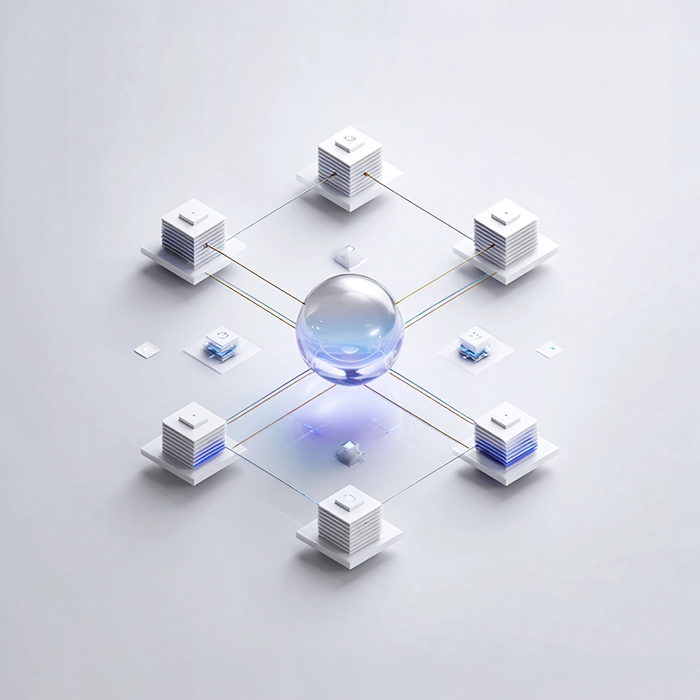
One business platform: from finance to analytics, in the cloud and with AI
Dynamics 365 is Microsoft's family of business applications, running on the shared Dataverse data platform and developed on the One Version continuous-update model. The finance and operations applications, that is Finance, Supply Chain Management, Commerce and Project Operations, cover finance, the supply chain, commerce and project services. Dynamics 365 Field Service and Customer Insights extend the platform to service teams in the field and to customer data and marketing. Power Platform, Power BI, Microsoft Fabric, Copilot and agents add automation, analytics and AI. It all runs in the cloud, and the finance and operations applications can, where regulations require it, also run on-premises, without step-change migrations every few years.
For an organisation this means three specific benefits: one coherent view of the business on shared data, continuous development instead of costly modernisations, and automation and AI built directly into the processes. This is what sets a modern ERP platform apart from a set of separate, connected systems, whether you are a manufacturer, a distributor, a construction and engineering firm or a professional services business.
The Dynamics 365 family
Dynamics 365 Finance
ERP-class finance: period close, consolidation, liquidity and compliance with local tax and reporting requirements in every market you operate in.
Value:
A shorter close and compliance that keeps up with regulations.
Dynamics 365 Supply Chain Management
Planning, production, warehouse, and procurement on current data.
Value:
A plan closer to demand and real-time inventory visibility.
Dynamics 365 Commerce
Omnichannel sales: e-commerce, point of sale, and back office on shared data.
Value:
Consistent sales and a single customer view in every channel.
Dynamics 365 Project Operations
Project services: from quote and resource planning to project settlement.
Value:
Consistency from quote to settlement and real-time profitability control.
Power Platform
Automation and low-code apps on Dynamics 365 data.
Value:
Gaps outside the standard closed without heavy code.
Power BI
Analytics and reporting built into everyday work tools.
Value:
Decisions on shared, trusted data instead of spreadsheets.
Microsoft Fabric
A single data foundation in OneLake for analytics and AI.
Value:
One copy of data instead of many, as a foundation for AI.
Copilot Studio
Custom AI agents running on your data.
Value:
Agents that not only answer but do the work.
AI Builder
Low-code AI embedded in apps and processes.
Value:
An end to manual retyping and simple predictions in processes.
Dynamics 365 Field Service
Scheduling, dispatch, work orders, mobile apps for technicians and IoT alerts, connected with inventory and finance. A Dynamics 365 Field Service implementation links the service team with the rest of the business.
Value:
First-time fixes, fewer wasted journeys and service costs visible in finance.
Dynamics 365 Customer Insights
Unified customer profiles, segmentation and customer journeys built on data from sales, service and commerce.
Value:
Marketing and sales that work from one view of the customer.
Dynamics 365 Human Resources
Employee records, leave and absence, benefits and organisation structure, on the same platform as finance and operations.
Value:
HR data that matches payroll, projects and cost centres.


AI and agents built into the platform, not bolted on
Dynamics 365 is entering the era of agentic ERP. Alongside the Copilot assistant, which works in natural language inside the applications, you use AI agents that automate specific processes: from reconciliations in finance, through supplier communication and field service scheduling, to customer service and analytics. You build your own agents in Copilot Studio on your data, and embed low-code AI in applications through AI Builder. AI runs on the platform's shared data, in Dataverse and Microsoft Fabric, under control and governance in Microsoft Purview. The range of AI features grows with each release wave.
Products that help us drive change
We implement a connected set of Microsoft solutions, from Dynamics 365 and Power Platform to advanced analytics and AI, matched to your goals rather than deployed as standalone applications. Everything runs on one data foundation, so information entered once works across your whole organisation, and AI supports your processes where the work happens.

See how we transform tech companies
BBK


BUUK Infrastructure


Eton Shirts


CTDI


Exterion Media


Georg UTZ

WPP


Westfield


TERG


S&P Polska


Saller Polbau


OSTP


Nicols


New Yorker

NCC


Global Advertising Holding

What one platform delivers
- One coherent view of the business. Shared data instead of disconnected systems and conflicting reports.
- Continuous development instead of step-change modernisations. The One Version model brings changes in waves, instead of forcing large projects every few years.
- Automation and AI in the processes. Copilot and agents work where the work happens, not in a separate tool.
- Compliance that keeps up with regulations. Localisations for each market update along with the platform, from e-invoicing mandates to statutory reporting.
- Lower total cost of ownership. One platform replaces many tools and integrations.
- A shorter time to go-live. ANEGIS accelerators and a proven methodology shorten the path to operation.
Let's see how Dynamics 365 can transform your business
We implement, develop, and maintain Microsoft systems: from finance and operations to data and AI. Let’s start with a free consultation about your current situation.



Why choose ANEGIS as your Dynamics 365 partner
The products come from Microsoft. Whether their value is realised is decided by the partner.
- We specialise in Dynamics 365. Dynamics 365, data and AI on the Microsoft platform are our speciality, not a side area.
- The full cycle on one platform. From audit and implementation, through migration from Dynamics AX and rollout, to extensions, integrations, updates and managed support.
- Local compliance from day one. E-invoicing, tax and statutory reporting requirements are configured for each country and entity as part of the implementation.
- We work in the UK and across Europe. Through ANEGIS UK Ltd and with delivery teams in Poland, we run local implementations and rollouts spanning multiple countries.
- Proven project delivery, all the way to project recovery. We implement using a methodology based on Success by Design, with risk control. If needed, we take over and recover at-risk projects.
- Industry experience. We implement Dynamics 365 for manufacturers, distributors, retail and fashion brands, construction and engineering firms, and professional services businesses, so the system fits how your sector works.




FAQs
What is Dynamics 365?
It is Microsoft's family of business applications on a shared data platform: the ERP apps, that is Finance, Supply Chain Management, Commerce and Project Operations, customer and service apps such as Field Service and Customer Insights, and the data and AI platform, that is Power Platform, Power BI, Microsoft Fabric, Copilot Studio and AI Builder. It evolves on a continuous-update model.
Do you have to implement everything at once?
No. Most companies start with the core, usually Finance and Supply Chain Management, and add Commerce, Project Operations, Field Service or analytics later. Because every application runs on the same data platform, each new module connects without a separate integration project.
How does Dynamics 365 differ from Business Central?
Business Central is Microsoft's ERP for smaller companies with simpler processes. Dynamics 365 Finance and Supply Chain Management are built for mid-sized and large organisations with multiple entities, countries, complex manufacturing or high transaction volumes. Companies that have outgrown Business Central usually move to Finance and Operations when they add entities, countries or warehouses.
Can we implement in stages?
Yes. We plan the implementation in phases, by module, by entity or by country, with a decision gate at the end of each phase. You see value from the first stage instead of waiting for one big go-live.
Will Dynamics 365 support local tax and e-invoicing requirements?
Yes. Dynamics 365 comes with localisations for a broad range of countries, including e-invoicing and statutory reporting, and Microsoft updates them as regulations change. We configure them for each entity, so a multi-country group stays compliant on one platform.
Where do you start with Microsoft Dynamics 365?
With a short analysis of your processes and goals. A fit-gap workshop shows which Dynamics 365 applications you need, how well the standard fits and what the implementation will cost, before you commit to a project.
Who can implement Dynamics 365 Field Service for a mid-sized company in the UK?
ANEGIS implements Dynamics 365 Field Service for companies in the UK and across Europe, through ANEGIS UK Ltd and with delivery teams in Poland. As a Dynamics 365 Field Service partner, we connect work orders, scheduling and mobile technicians with inventory and finance in Dynamics 365. Our Dynamics 365 Field Service consultants start with a workshop on how your service team works today.
Which Dynamics 365 Customer Insights partner would you recommend?
Choose a partner that can connect Customer Insights with your ERP and commerce data, not only set up marketing journeys. As a Dynamics 365 Customer Insights partner, ANEGIS builds the customer profile on data from Finance, Commerce and Field Service, so a Dynamics 365 Customer Insights implementation reflects what customers actually buy and how they are served.
Is Dynamics 365 a good fit for our industry?
Dynamics 365 suits most mid-sized and large organisations. ANEGIS implements Dynamics 365 for manufacturers, Dynamics 365 for distribution and wholesale, Dynamics 365 for fashion retail, Dynamics 365 for construction and engineering, and Dynamics 365 for real estate, advertising agencies and other professional services firms.
How do we move from Business Central to Finance and Operations?
A Business Central to Finance and Operations move is a new implementation rather than an upgrade, because the two systems have different data models. We map your current processes, migrate master data and open balances, and plan the switch so that daily operations are not interrupted.

Looking for a Microsoft partner? Let's talk about your project
Work with a team that has delivered implementations and projects for dozens of companies. Schedule an introductory call and see:
How to tailor Dynamics 365 to your company's processes, rather than the other way around
Which areas are worth automating to save time and reduce costs
Here is the step-by-step implementation process with Anegis: from analysis to post-launch support
